Horses have always been an integral part of the US Border Patrol since
its beginning in 1924. By 1935, the Border Patrol began using motorized
vehicles with radios to patrol the US/Mexico border, but rugged terrain
and the need for quick and quiet transportation guaranteed that horses
would remain essential to the Patrol.
In 2012 the RGV Sector of Border Patrol established a Horse Border
Patrol Unit beginning with 8 horses and 8 riders. Initially the horses
were commercially boarded at taxpayer expense. Soon the BP HPU
was able to make a usage agreement
with US Fish and Wildlife
to utilize acreage south of Mission,
Texas which is a part of a
USFW refuge. This was a win-win
situation all around. US Fish and
Wildlife appreciated the increased
presence of BP on the refuge
without the environmental impact brought on by motorized vehicles.
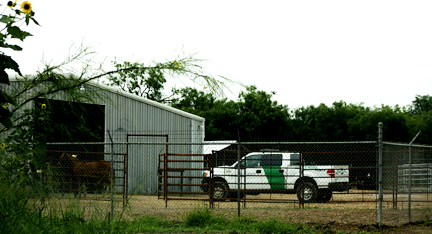
Border Patrol Horse Patrol Unit now has its
own compound where horse and rider can both
receive thorough training. A goal was set by BP
HPU to increase its regiment to 40 horses and
riders which was met in July, 2015.
About The Horses
There is scientific evidence of horses in North
America during prehistoric times, however
they went extinct here over 11,000 years ago.
The horse was reintroduced to the Americas by
Spanish explorers in the 1500s. These were domesticated
animals which were left to run wild.
Soon there were herds of feral horses, commonly
referred to as mustangs, roaming freely
across much of the Western United States.
As of March 1, 2015 it is estimated that the
wild horse and burro population on Bureau of
Land Management (BLM) lands in the West
is 58,150.
See Current updated info from BLM
Find more info on Wild Horses and Burros in the US at
worldanimalfoundation.org
Appropriate Management Level
(AML), defined by BLM as the number of
wild horses and burros that can exist in balance
with other public land resources and uses
is only 26,688. This overpopulation of feral
horses is managed by BLM's Wild Horse and
Burro Adoption Program. Since 1971 more
than 230,000 wild horses and burros have been
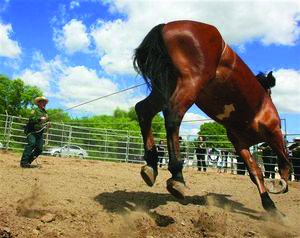
placed into private care. Horses and burros are
rounded up and taken to various correctional
facilities where inmates have received the training
to bring the horses to "green broke" status.
Forty of these horses originating from Kansas'
Hutchinson Correctional Facility have been
hand-picked and are now an integral part of the
Border Patrol RGV Sector. At the Horse Patrol Unit facility in Mission these horses receive an additional 60 - 90 days of training under the supervision
of BP HPU Training Supervisor Manuel Torresmutt.
Why BLM Adopted Horses?
Horses are a prey animal and have a keen
sense of awareness which protects them from
becoming a predator's meal. By utilizing
BLM's wild horse adoption program, BP HPU
is starting with a horse whose natural, wild instinct
to survive provides the rider with a unique
set of tools. The horse will sense the presence
of potential danger long before a human would
realize it is there. The agent becomes alerted
by the horse's body language such as cropped
forward ears, flared nostrils and an increased
heart rate. As the threat of danger gets closer
the horse will become a bit restless as if ready
to take flight. Another advantage that the
horse provides is silence and
the ability to cover a large area
in a short amount of time. Here
along the TX/MX border BP
agents often times are fulfilling
their duties in thick brush. Motorized
vehicles are noisy and
cannot cover some of the terrain
necessary to traverse. Horses on
the other hand are quiet and very
adept at maneuvering among the
thick mesquite and scrub brush.
A bond is formed between
horse and the rider which makes
them an invaluable asset.
Preferably, agents and horses are paired during
training giving them the opportunity to gain
each others trust and develop communication
through body language. This extensive training
received by horse and rider allows them to
function as a singular unit.
Training Supervisor Manuel "Manny" Torresmutt
tells the story of one incident which
occurred while out on patrol that accurately depicts
the true advantage and nature of the team
work between horse and rider in the BP HPU.
"We were on duty waiting to receive word
from our remote spotters of aliens in our area.
My horse, Smokey, began to signal to me that
something was up. His ears pointed forward
and I could feel his heart rate increase. I radioed
to our spotters and asked if they saw any
activity in our area. The reply came back 'all
clear'. As the moments passed, Smokey continued
to tell me someone was out there. He
started moving his feet restlessly as if he anticipated
that we would soon be giving chase. I radioed
again, and again the reply came back 'all
clear'. Within a few moments our spotter radioed
back and verified that they had now indeed
spotted a group coming our way. There were
two forward scouts and a group
of a dozen or so several yards
behind. Smokey was ready to
go, however I held back on the
reins allowing the two forward
scouts to pass by knowing that
they would be apprehended by
the spotters. Smokey simply
could not understand what I was
doing, weren't we going to go
get those guys? He became a
bit fidgety and finally turned his
head looking me straight in the
eyes as if to say,
Come On! Lets
GO! And so we did, rounding up
the main group."
Public Appearances
The Border Patrol Horse Patrol Unit proudly participates in parades and public
events in the RGV. Most recently they were a part of the Fourth of July Parade in McAllen, TX.