
The Little Paper You'll Want To Keep and Share!
February 2016
Vol. 2 No. 9
download pdf of this issue
Visit our Facebook page
February 2016
Vol. 2 No. 9
download pdf of this issue
Visit our Facebook page
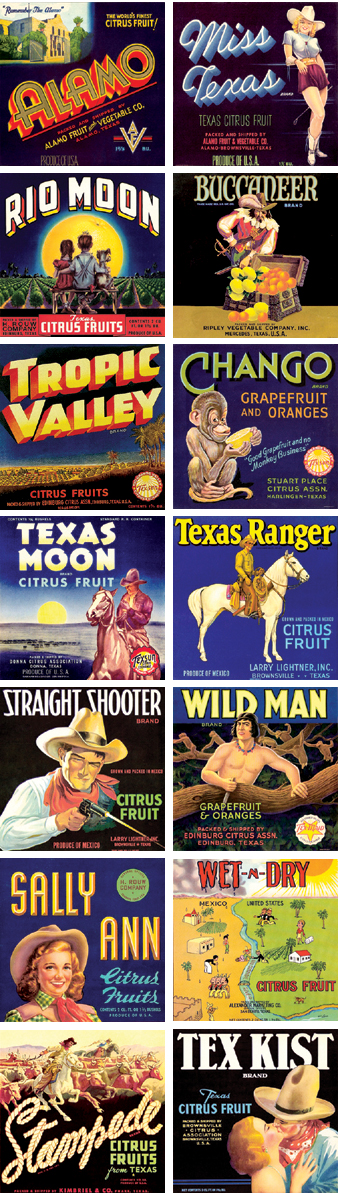
February is
National Grapefruit Month!

National Grapefruit Month!
The first reported planting of a grapefruit tree grove in Texas
was in 1893. In 1914, John H. Shary, a developer originally
from Omaha, Nebraska, bought 16,000 acres of brush land
and after clearing it, proceeded to grow his first crop of seeded
white grapefruit. Impressed by the small crop raised by early
citrus experimenters, Shary was sure that citrus was the crop
of the future for South Texas.
The first commercial shipment of citrus left the Lower Rio Grande Valley in 1920. In 1929 an accidental discovery of red grapefruit growing on a pink grapefruit tree gave rise to the Texas Red Grapefruit Industry.
Thus, the Texas citrus industry began, leading to a peak of more than 100,000 acres in the 1940s. Moreover, Texas' reputation for quality red grapefruit production was established by the varieties which originated within the Valley. Freezes of the late 1940s, 1951, 1962, 1983, and 1989 as well as urbanization, other land use, overall citrus economics, and other factors combined to lower citrus acreage to an estimated 27,000 acres in 2005.
Read More About The Grapefruit
The first commercial shipment of citrus left the Lower Rio Grande Valley in 1920. In 1929 an accidental discovery of red grapefruit growing on a pink grapefruit tree gave rise to the Texas Red Grapefruit Industry.
Thus, the Texas citrus industry began, leading to a peak of more than 100,000 acres in the 1940s. Moreover, Texas' reputation for quality red grapefruit production was established by the varieties which originated within the Valley. Freezes of the late 1940s, 1951, 1962, 1983, and 1989 as well as urbanization, other land use, overall citrus economics, and other factors combined to lower citrus acreage to an estimated 27,000 acres in 2005.
Read More About The Grapefruit

Providing Help through Disaster Response
by Alma Seong
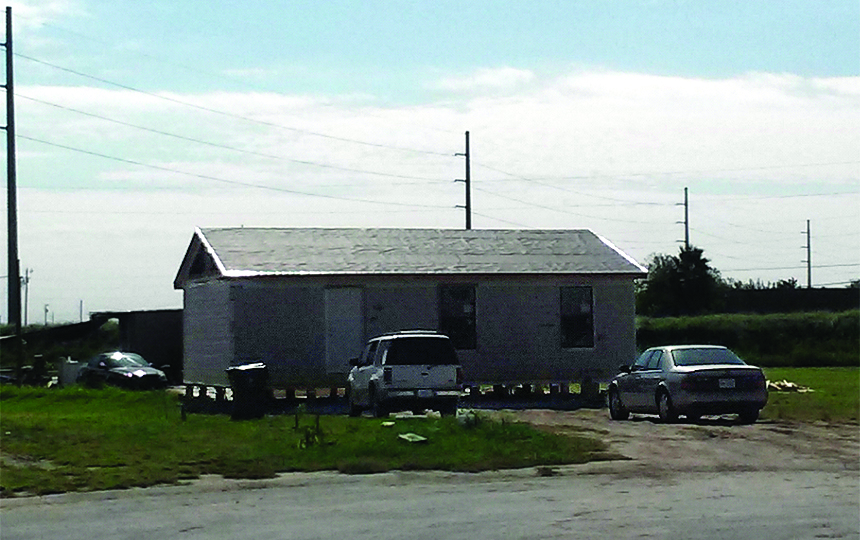 On April 25, 2015 a severe storm hit the valley. In fact, the American Red Cross declared certain areas in the Rio Grande Valley a disaster zone. Since then, there have been a series of storms that have left hundreds of people with heavily destroyed homes. The victims' homes were totally or majorly collapsed with their belongings thrashed and scattered, leaving them exposed to nature or even without a home. Those and other families were forced to look elsewhere for a place to stay until they re-construct or until they repaired their homes, but with little to no funds at their disposal, that is a very difficult task. In response to that, CCRGV's Disaster Relief Program helps these families reach their pre-disaster stage.
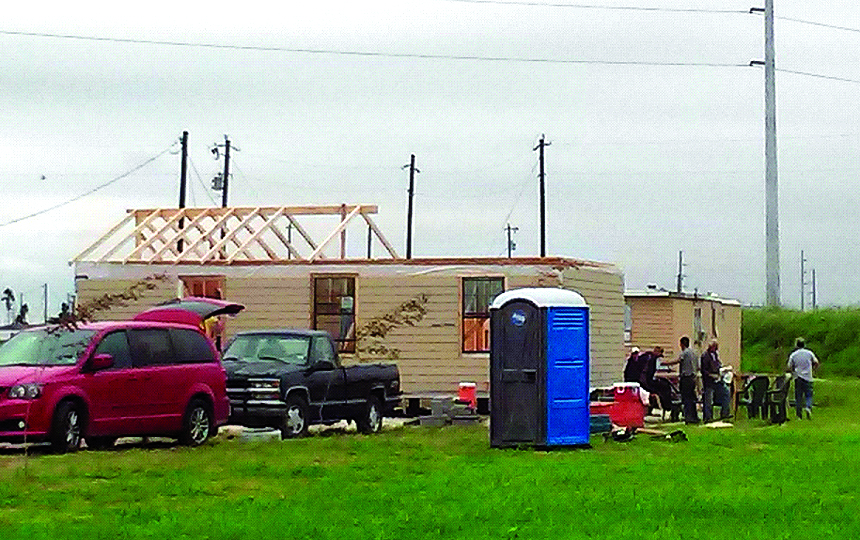 CCRGV helps with Disaster case management, home assessments, building materials, and volunteer repair labor if needed; Disaster managers attentively aid clients whose home was affected to make sure that the home is repaired as soon as possible after receiving their building materials. Additionally, CCRGV partners with the Salvation Army, Faith Community and Disaster Recovery (FCDR), Federal Emergency Management Agency (FEMA), and other voluntary organizations active in disaster to better serve clients.
 This past year, through the Disaster Relief Program, donors, as well as other partner organizations, CCRGV helped many families whose homes were affected.
One of many was a family of two adults and four children who were living in a borrowed trailer house that had been identified by the Red Cross as a complete loss. Through assistance with building materials, disaster case management, and volunteer repair labor, the family now has their house re-built. Their dignity has been restored as their house is in livable conditions as it was before the storm. They are no longer worried about inclement weather conditions.
Help us continue being that beacon of light and hope to families of the RGV still in need through your support and/ or contribution. To give a donation, please send a check payable to Catholic Charities of the Rio Grande Valley to the following address:
Catholic Charities of the Rio Grande Valley
PO BOX 1306
San Juan Texas 78589
In the side or memo part of the check, please write: Disaster Relief Program
For those interested and able to assist us with volunteering with the Disaster Relief Program, please contact Simon Casas at scasas@cdob.org or at (956)702-4088.
On behalf of all of us at CCRGV and those we serve, we look forward to hearing back from you and we truly thank you for your help.
Ouch! I'm a Hurting Canadian Winter Texan
by Wilma Jacobs, MBA, a long-time Canadian Winter Texan
$18,000! I was shocked to realize that's what the average Canadian Winter Texan is spending (in Canadian dollars) if he or she owns a mobile home and stays here for five and a half months this season.
My husband and I have been staying in the Valley at one of the larger resorts since 2004, moving from first a motor home, to a mobile home in 2008. We really enjoy being in the Valley; the warm weather, the friendliness of the people, the close proximity to Mexican culture (which we love), and the many amenities for having fun. It's a unique place.
We are typical of many Canadian winter residents in that we fit the following categories:
• We are between 60 and 80 years old.
• We travel 3,700 to 7,400 miles (round trip) to get here.
• We stay five and a half months from November to April.
• We currently pay $1.44 Canadian for $1.00
Not counting the capital outlay to buy a mobile home (ranging in price in our resort from $17,000 to $125,000 US, equivalent to $25,000 to $180,00 Canadian), we incur the following costs.
Operating Costs: ($US) ... ($Cdn)
Lot Rent (annual) --- 6,376 ($US) ... 9,181 ($Cdn)
Out-of-Country Health Health Care Coverage --- N/A ($US) ... 4,000 ($Cdn)
Property Taxes --- 1,000 ($US) ... 1,440 ($Cdn)
Home Insurance --- 800 ($US) ... 1,152 ($Cdn)
Pest Control --- 120 ($US) ... 172 ($Cdn)
Landscaping (lawn maintenance) --- 350 ($US) ... 504 ($Cdn)
Fuel (average round trip) --- 500 to 1,000 ($US) ... 750 to 1,440 ($Cdn)
Total Operating Costs --- $9,396.00 ($US) ... $17,344.00 ($Cdn)
The Operating costs listed here do NOT include costs for: groceries, entertainment, restaurant meals, gasoline used while in Texas, mobile home repairs and upkeep, water and electricity.
When you include the above, Operating Costs work out to, on average, well over $Cdn 18,000.00 per season.
Canadians make up a large percentage of Winter Texans, in our Resort over 50%, and we spend a lot to support the local economy in the Valley. But it is becoming more and more difficult to justify this expense, certainly in large part due to the dollar difference, but also due to increasing lot rental costs, mounting local taxes and increasing costs for out-of-country health care coverage (which goes up every year as we age).
One saving grace is that gasoline prices this season are much more reasonable. Unfortunately however, this is the very cause of our depreciated Canadian dollar).
It is reasonable to see why many of the parks & resorts in the Valley have much lower occupancy rates this year. Many of our Canadian friends here have put their homes up for sale or are staying for a shorter time this year.
There is no light at the end of the tunnel yet since oil prices (the major determinate of Canadian dollar value) do not seem likely to rise any time soon.
Are there any immediate solutions? Yes!
Offering park / resort fees and other services at Canadian par would certainly attract more residents, as would summer discounts on lot rentals (when we aren't here to use the amenities).
Canadian fees at par were tried here in the Valley in 2003, the last time there was such a difference between the US and Canadian dollar. And it worked!

Leap Day - Monday, February 29
Leap Day is every fours years....almost.
It's every four years except years ending with "00" that are not divisible by 400. The year in which Leap Day occurs, is called a Leap Year.
Why the fancy calculation? The earth rotates around the sun once every 365 and about 1/4 days. So, by adding an extra day every four years, we get mighty close to keeping the calendar consistent with the earth's annual trip around the sun.
And to be very precise, the earth orbits the sun every 365.242190 days. So, on years ending in "00", (except those not divisible by 400) we skip Leap Year and Leap Day. With all that fancy calculating out of the way, let's just celebrate the day.
Did you know?
There are occasional "Leap Seconds". We will spare you the detail on those, except to say it helps to correct minor variations.
On December 31, 2015, the folks who maintain the official time for the planet, will add an extra second to the day!
If your birthday is on Leap Day, congratulations, you finally get to celebrate your birthday on your birth date. Just how many of us are celebrating our Birthday on Leap Day? Only about one in 1461 people. If you were born on this day, consider yourself very, very special.
True Tales of a Valley Birder
Best Birding in Texas is South Texas
by Keith Hackland (alamoinn@aol.com)
photo credits: Steve Sinclair
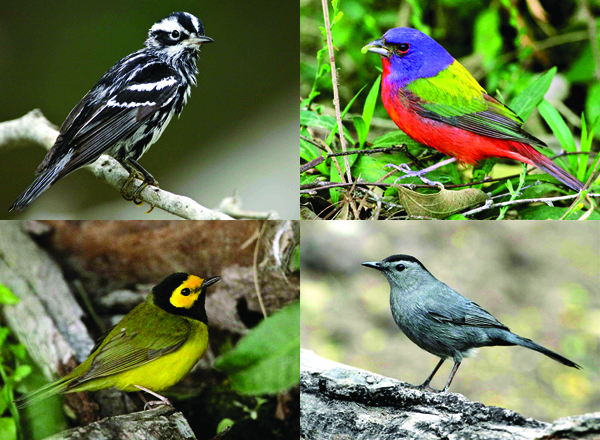
Texas leads the United States and Canada in birding. Our state has some 640 species on record. That count is governed by the Texas Bird Records Committee, a group of experts who are very careful before recognizing a new species to add to the state list.
There have to be good photos and reports by reliable birders who are known in the birder community. It also does not normally include escaped (exotic, feral) birds, even if they are breeding.
How Many and Where
The best birding in Texas is in South Texas, along the coastal wetlands and Rio Grande wetlands, and adjoining areas. For most of the coastal areas 75% of the birds found in Texas use these areas of South Texas, that is about 480 species. Some of these 480 species are full time residents, some part time seasonal residents, while others pass through as migrants. 338 species are migrants, moving through the area or wintering here. Some 147 species reside year round.
In United States there are 338 migratory bird species. 333 of these, 98%, are found in South Texas. This makes South Texas of great importance. It is an area where species come and go, a canvas of birds, changing seasonally, changing with weather variations, and changing with geography, and changing with habitat.
Seasonal Changes
Seasonal changes are easily understood. In the fall, migrants, neo tropical species, return south to their homes after nesting in U.S. and Canada. They take their time, using southern winds to help them fly south, feeding on fall harvest delicacies of fruit, grain, nuts, insects, mammals and other birds.
Fall migration takes place from June through December, though the heaviest migration is August through November, when hawk watch takes place, counting raptor migrants. This is done at Smith Point and Sylvan Beach in South East Texas, and at Hazel Bazemore Park on the Coastal Bend outside Corpus Christi. This latter count point sees the highest counts.
Migrants
There are three major migratory flyways that lead birds into Texas: Eastern Atlantic flyway (which brings mainly land migrants), Mississippi Flyway and Central Flyway (which bring all migrants). Two types of migrants cross Texas, the circum Gulf (land) migrants and the cross Gulf migrants. The fourth North American flyway is the Western Flyway, and some of its birds also use Texas lands.
Large migrant species, such as raptors and water birds follow the land, meaning that when they reach the Gulf of Mexico, they turn west and follow the coast around through Texas into Mexico and continue south over land. Land migrants are generally heavier birds that do not have the ability to fly across the Gulf of Mexico.
Some species fly at night, resting up and eating during the day. The day flying species take advantage of thermals. Thermals are columns of warm air rising off the land. Birds use the columns as elevators, allowing the rising air to lift them thousands of feet into the air. When they are high up they leave the elevator and glide for tens of miles, until they find another thermal to ride up. Birds riding on these air elevators do so in flocks, called kettles. Kettles can be seen from many miles away, which is helpful to the birds who are seeking them.
Smaller, lighter migrants, including song birds, humming birds, and shorebirds, have the ability to fly right over the Gulf of Mexico. They typically do this at night, flying for up to 16 hours to reach land, often covering around 800 miles. They depart from the Gulf Coast at many points, preferring land that reaches out into the Gulf, generally in Texas the Barrier Island at Galveston, Mustang, and Padre. Spring migration is a much more concentrated affair, which sees song birds hurrying through to reach their breeding grounds while insect life is at its peak. Insects provide the essential protein for nestlings. The raptors move through first from mid-March through late April. There are hawk watch counts in South East Texas at Sylvan Beach, and in the Lower Rio Grande area at Bentsen Rio Grande Valley State Park, and at Santa Ana National Widlife Refuge.
The song birds follow, from early April to the end of April in South East Texas, and continuing to late May in the Lower Rio Grande area. Since song birds prefer to fly when they have a tail wind, they tend to leave in concentrated groups when conditions are ideal. Researchers count migrants as they fly overhead at night. They use audio devices to record their calls and then estimate the numbers of calls. This is being done in and adjacent to the Lower Rio Grande Valley. At peak times at a given point the number of calls recorded indicates one million birds per hour passing overhead. This is the heaviest migration rate recorded on earth.
HELPING HANDS at Alamo Rec Veh Park
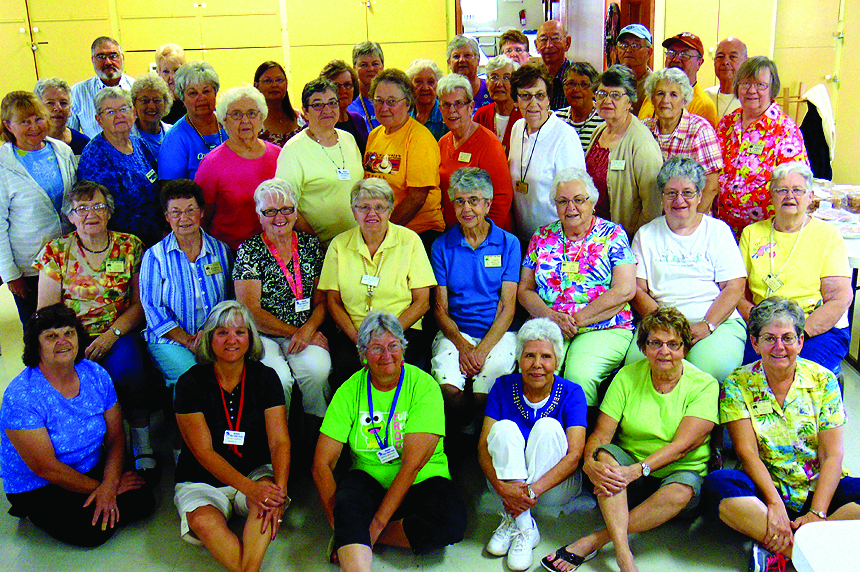
HELPING HANDS Sewing Group, formerly known as Mission Sewing, has been in existence since approximately 1983 and was started with a group of 23 women and no men.
The group now consists of male and female volunteers who meet on Tuesday mornings in the Annex at Alamo Rec Veh Park in Alamo, TX.
 Over the 32 years of existence several thousand quilts have
been made and hundreds of residents in the Valley have benefited.
In 1983 the quilts were made using templates and scissors
to cut the blocks, eventually moving in to the modern
world of rotary cutters and rulers.
Over the 32 years of existence several thousand quilts have
been made and hundreds of residents in the Valley have benefited.
In 1983 the quilts were made using templates and scissors
to cut the blocks, eventually moving in to the modern
world of rotary cutters and rulers.
Gradually, over the years, they added making bibs and afghans for the nursing homes and crocheted and knitted chemo hats for children. Helping Hands owns and furnishes all supplies and sewing machines needed to keep the volunteers busy at these tasks. Maintenance and furniture moving is also taken care of by volunteers.
We have been very fortunate in receiving quilt tops from a group up north as well as those we make. On Tuesdays, we have a production line of cutters of blocks; pinning the tops together; sewers; sandwiching of tops, batting and backing; sewing of binding and labels and then to the tyers to complete the quilts. The quilts are made in three sizes; adult, youth and toddler and are donated to hospitals, nursing homes, colonias, fire departments, the Children's Cancer Center, Women's Shelter and the Silver Ribbon Program for abused and disabled adults.
All of the projects are made by volunteers and the costs are met by donations and funds raised at the Quilt and Hobby Show. Residents also collect toiletries during their travels from motels/hotels and these are given out to the Women's Shelter and colonias.
All residents at Alamo Rec Veh Park who are hospitalized receive a quilt to show our support, comfort and keep them warm during their recovery. The Quilt and Hobby Show held the first Thursday in February is sponsored by Helping Hands and residents are encouraged to enter the show and show off their talent in woodworking, painting, jewelry making, knitting, crochet etc. and of course, quilting. There are multiple door prizes and a quilt given away during the show to lucky winners. This show has become a very successful endeavor and is known throughout the Valley.
All proceeds from the show and donations go to support Helping Hands in the costs of this great endeavor. We continue to strive to assist meeting the needs of the needy in the Valley through our wonderful Volunteers.
National Freedom Day - Monday, February 1
Major Richard Robert Wright Sr., a former slave, created National Freedom Day. He believed that there should be a day when freedom for all Americans is celebrated. President Lincoln signed the 13th Amendment outlawing slavery on February 1, 1865.
The first commemoration of such a day took place on February 1, 1942, although it was not made into law yet. A tradition of laying a wreath at Liberty Bell also began.
On June 30, 1948, President Harry Truman signed a the bill proclaiming February 1st as National Freedom Day to remind us that America stands for, and is a symbol of freedom for all people.
Celebrate this day by reflecting upon your own freedoms and remember that millions of people in the world are not free.

New Year, New Home
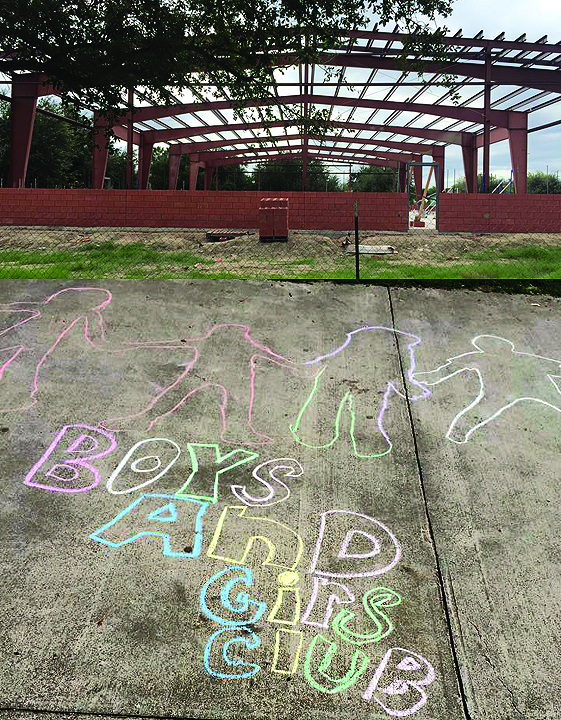 There is much to look forward to this year at The Boys and Girls Clubs of Weslaco Inc. The board is proud to announce that ground has been broken! The building's steel structure is currently erected, bricks are being laid and the interior designing has commenced. This brand new site will be opening in the month of April and as mentioned in September, will feature a computer room and classrooms for more space to learn, a kitchen for preparing healthy meals and snacks, and a full court gym.
The club will continue to offer flag football, and baseball leagues. You can now expect volleyball leagues, men's and women's basketball leagues, fitness classes and much more.
With all this new space the possibilities are endless! We are currently serving 120 members at our present site and with the new facility we will be able to more than double the amount of members. The new site will be located at Pablo Pena Park on Airport Drive.
Best Memories of 2015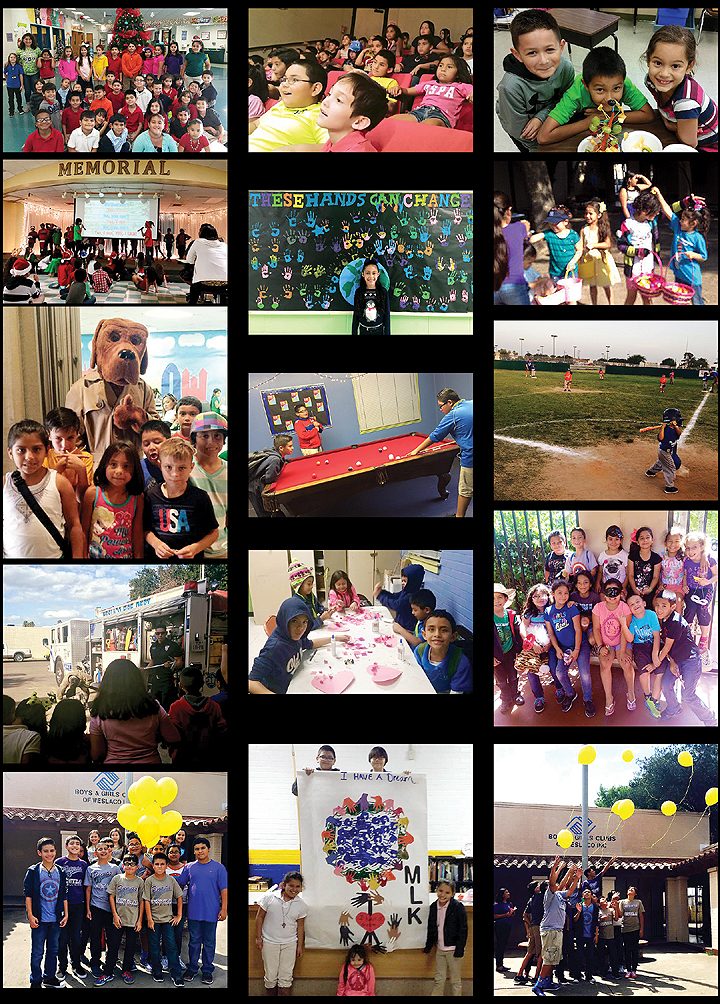
Although there is so much to get excited about looking towards the future of The Boys and Girls Clubs in Weslaco, this year was one for the books! This past year was full of fun and games, learning and creativity, and raising awareness. The students participated in activities and events such as a magic show in the auditorium, healthy habits, pool tournaments, arts and crafts, fire and cancer awareness and much more. Awards and recognition were given to this past year’s Speedy Readers and Junior Youth of the Year.
For the holidays Old St. Nick visited the kids and brought Christmas gifts and goodies for everyone. After taking their photo with Santa the kids were in for a real treat! Santa Clause hung around and read them a good old Christmas story in front of the fireplace. Moments like these at The Boys and Girls Club truly brings joy to all.
Special Thanks
This last year has been great to all of us here at the Boys and Girls Clubs of Weslaco Inc. We can't wait to see what's in store for next year! The board would like to extend a special thanks to its directors and staff for making it a successful 2015!
The Boys and Girls Clubs of Weslaco Inc. impacts the lives of young people in vital areas such as academic success, good character and citizenship, and healthy lifestyles.
Volunteer South Texas Week 2016 is almost here!

United Way of South Texas has announced that the week of April 10-16, 2016, (Sunday through Saturday) will be Volunteer South Texas Week 2016, a week to showcase to the world the many ways South Texans passionately serve in their communities!
Last October, United Way of South Texas launched Volunteer South Texas volunteersotx.org , a FREE "one-stop-shop" for potential volunteers to connect with non-profit agencies, schools, and governmental institutions in our communities.
This website Is a new opportunity to connect volunteers with meaningful service projects right here in Hidalgo and Starr Counties of South Texas.
Over 60 non-profit agencies, schools, and governmental institutions have already signed up on Volunteer South Texas and are now able to easily advertise volunteer opportunities, in-kind needs, and special events to our communities.
Potential community volunteers can now browse what needs exist and then register to volunteer to fill a specific need and/or to be automatically notified when volunteer opportunities arise around their passions. Registration can even be done right on your smartphone!
To celebrate Volunteer South Texas Week 2016, over the next couple of months, non-profit agencies, schools and governmental institutions throughout South Texas will post needs for volunteers specifically for the week of April 10-16.
United Way of South Texas will publicize the week's opportunities for service. Volunteers will then click on the "Respond" button on Volunteer South Texas on the opportunity in which they want to serve and the individual agencies will contact each volunteer to schedule the specific tasks needed that week. T-shirts will be given to all participants in the week’s service projects who have signed up through Volunteer South Texas.
McAllen Mayor Jim Darling (our Honorary Volunteer South Texas Week 2016 Chairman) and the mayors of many of the communities in Hidalgo and Starr Counties will lead us as we serve at food pantries, in after school programs, or at a beach cleanup (examples only).
Once the week's activities are completed, we'll tabulate the number of volunteers that served in our communities, the number of hours served, and the value to our communities from this week of volunteer service.
Make plans to join us April 10-16, 2016, for Volunteer South Texas Week 2016! Check back on Volunteer South Texas volunteersotx.org often and reserve your spot at a community agency near you!

Jeepers Just Want To Have Fun!
by Alyssa Cavazos
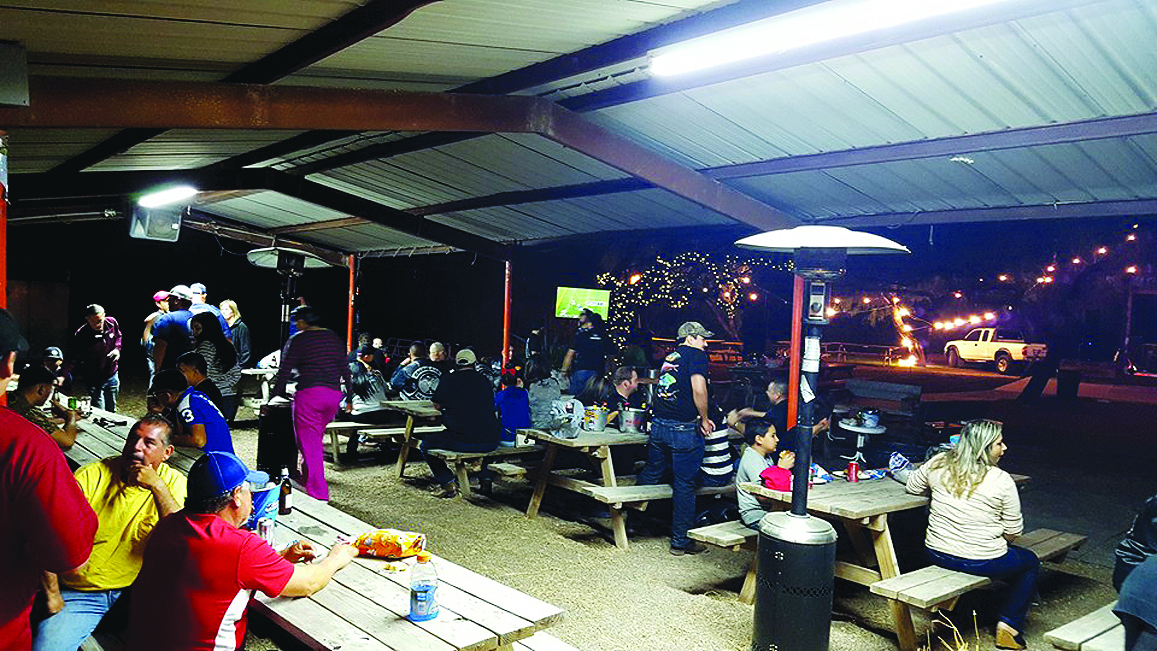 Jeep Night this January was intended for Jeepers to meet up and have a leisure evening. This month we took a break from the competitions and just enjoyed each other's company. Sofie's 'SS' Saloon was the spot for the monthly meeting.
Burns Motors' David Nunez delivered once again and grilled up some barbecue for Jeep Night, which was sponsored by Burns Motors. The hours flew by as guests enjoyed good food, great music, and awesome company. With the pressures of competition and awards absent, Jeepers were able to hang loose and intermingle.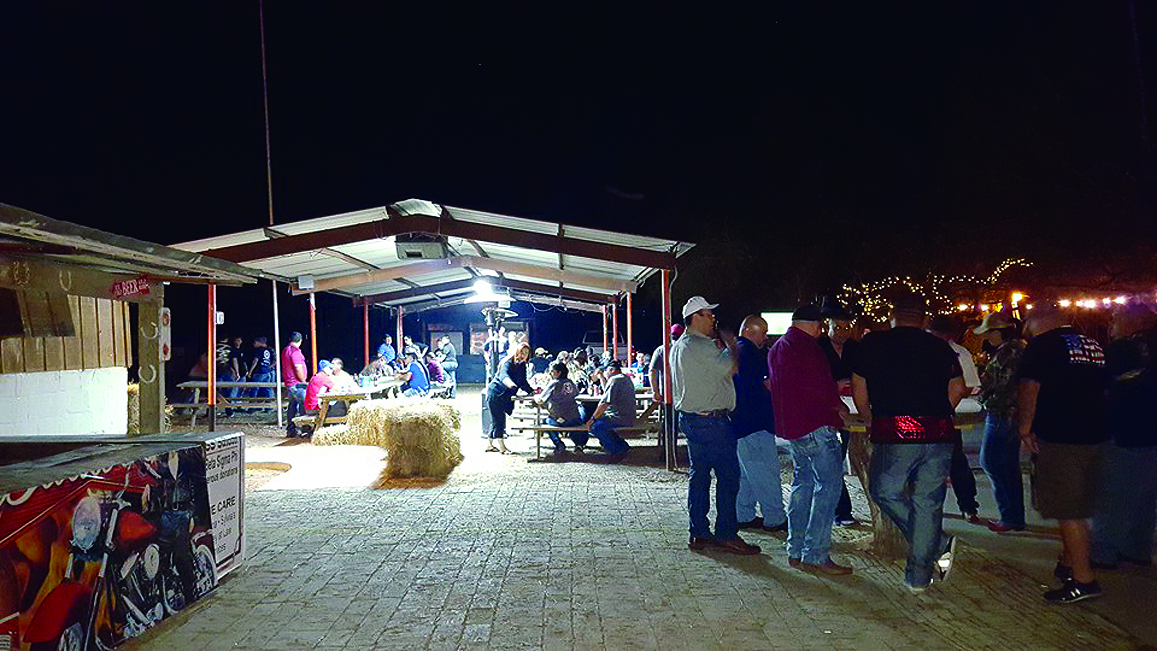 As everyone knows, Super Bowl Sunday is just around the corner.
Jeep Nights are usually held on Thursdays but February's Jeep Night theme will be "Super Bowl 2016" Party and of course will be held on Sunday, February 7.
Burns Motors' Big Lew was generous enough to host February's Jeep Night at his home in San Manuel. For those attending next month Jeep Night, it will begin at 3:00pm. Barbecue will be ready by 5:00pm and the game will be starting at 5:30pm. Guests will also enjoy other activities such as basketball, football, and corn hole. It is recommended guests bring seats with them.
For more information on next month's Jeep Night, such as Big Lew's address or directions to the location, please contact:
Burns Motors' Big Lew, Texas Jeep Crawler's Lou Bar, Texas Off-Road Republic's Jesse Pena, or South Texas Rebels' Fred Marroquin.
To keep updated on all Jeep Night information and events be sure to like our official Facebook page "Jeep Night powered by Burns Motors".
For additional information or questions Big Lew can also be contacted at 956-984-4454 or by email at biglew@burnsmotors.com
Be My Valentine
Valentine's Day is the day when people show their affection for another person or people by sending cards, flowers or chocolates with messages of love.
Traditionally on Valentine's Day in a leap year - every four years - women can propose marriage to their partner!
The day gets its name from a famous saint, but there are several stories of who he was. The popular belief about St. Valentine is that he was a priest from Rome in the third century AD. Emperor Claudius II had banned marriage because he thought married men were bad soldiers. Valentine felt this was unfair, so he broke the rules and arranged marriages in secret.
In the United States, about 190 million Valentine's Day cards are sent each year, not including the hundreds of millions of cards school children exchange.
Valentine's Day has become a popular gift-giving event. In fact, in the United States alone, the average valentine's spending has increased every year, from $108 a person in 2010 to $131 in 2013.
 The Magic Valley's Golden Egg
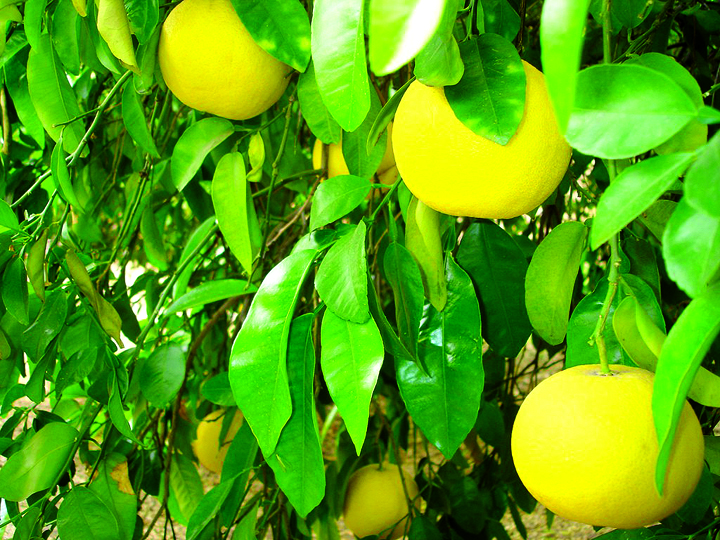
The origin of the Grapefruit has been a puzzle to historians and pomologists for years. The only citrus strain not found to have originated in Southeast Asia, the grapefruit was obtained in the West Indies around the 1700s. Years later, research confirmed that grapefruit is a hybrid of a pummelo, and the sweet orange.
Originally known as "the forbidden fruit", it wasn't until the 1800s that a Jamaican farmer called the fruit "grapefruit" for the grape-like cluster in which it grows on trees. In 1823, grapefruit made its way to the United States in the form of seeds brought by either Spanish or French settlers to Florida, eventually making its way to South Texas, most likely by visiting Spanish missionaries.
The Father of the Texas Citrus Industry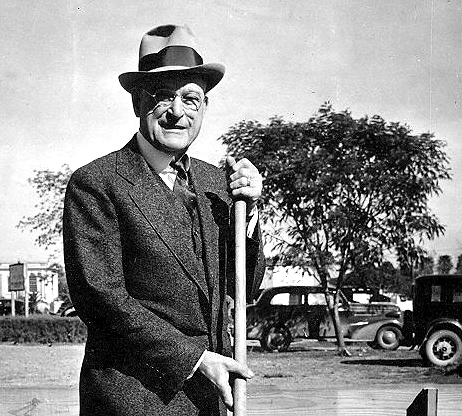
In 1912, John H. Shary made his way to the Rio Grande Valley which was at the time largely brush and cactus. Shary was impressed with citrus crops that were being grown by early citrus experimenters and saw a great opportunity in developing the Valley as a citrus growing region.
Citrus crops needed irrigation and in 1914 Shary purchased the First Lift Station which pumped life giving water from the Rio Grande to irrigate 15,000 acres of surrounding crops.
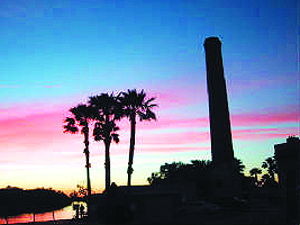 The chimney from the lift station has been
designated a Texas historical landmark and is still standing at the site of Chimney Park in Mission, Texas.
The chimney from the lift station has been
designated a Texas historical landmark and is still standing at the site of Chimney Park in Mission, Texas.
That following year Shary planted the first commercial citrus orchard. His first crops were seeded white grapefruit. His citrus empire would eventually grow to almost 15,000 acres of groves. The first commercial shipments of citrus, packed in onion crates, were shipped from the lower Rio Grande Valley in 1920. By 1922 much of the land had been transformed into citrus groves, and cotton, onion, and vegetable fields.
Shary took the lead in organizing and building the United Irrigation Company, in order to assure water supplies for future developments.
Because of his significant role in the development of the area, Shary was named to the Texas Business Hall of Fame and is remembered as the "Father of the Texas Citrus Industry".
He greatly assisted in the establishment of citrus as a productive commercial crop in the Rio Grande Valley. Since 1932, the Texas Citrus Fiesta has been held to commemorate the abundant harvest of the Texas citrus industry. To this day, this area is known for producing some of the sweetest and best quality citrus in the world.
Grapefruit Has Many Healthy Benefits
But Beware of Combining It With Some Prescription Drugs
 Grapefruits are low in calories but are full of nutrients and an excellent source of vitamins A and C.
Grapefruits support clear, healthy skin, can help to lower our risk for many diseases and conditions and may even help with weight loss as part of an overall healthy and varied diet.
According to the American Heart Association, eating higher amounts of a compound found in citrus fruits like oranges and grapefruit may lower ischemic stroke risk for women.
The powerful nutrient combination of fiber, potassium, lycopene, vitamin C and choline in grapefruit all help to maintain a healthy heart. As an excellent source of the strong antioxidant vitamin C as well as other antioxidants, grapefruit can help combat the formation of free radicals known to cause cancer.
Lycopene intake has been linked with a decreased risk of prostate cancer prevention in several studies and foods high in vitamin C and beta-carotene have been shown to lower the risk of esophageal cancer in particular.
Grapefruit, because of its water and fiber content, helps to prevent constipation and promote regularity for a healthy digestive tract.
As one of the most hydrating fruits in the world made up of 91% water (just below watermelon) and full of important electrolytes, grapefruit is a great snack to have on hand to prevent dehydration.
The risks for developing asthma are lower in people who consume a high amount of certain nutrients. One of these nutrients is vitamin C, found in many fruits and vegetables including grapefruit.
NOTE:
Some individuals who take prescription medications should be extra cautious when incorporating grapefruit into their diets. Grapefruit has a strong interaction with some of the most widely prescribed medications.
Why? Grapefruit contains a compound called naringenin that inactivates cytochrome P450 3A4. This slows down the normal detoxification and metabolism in the liver and intestines, which makes it harder for the body to eliminate and breakdown the drug. Not only can grapefruit decrease the function of a drug, but it can also enhance making the drug more potent. Both of these side effects are no good when you're trying to regulate a medical condition with a prescription drug. Best advice is to do your research and ask your physician.
Eating Grapefruit
There are many ways to enjoy fresh grapefruit. The simplest is to peel it, pull the sections apart and eat it just as you would an orange.
Because grapefruit has a sweet / bitter flavor many folks will cut it in half, separate the sections from the membranes and sprinkle a little sugar on it. Then you just dig in with a spoon.
If you are a bit more adventurous you can try the recipies shown here or find more ways to enjoy grapefruit at www.texasweet.com
However you decide to eat it, remember to thank those early pioneers who had the foresight to develop our Magic Valley into the Citrus Capital of Texas!

Grapefruit Brulee
Cut a grapefruit in half, then cut between the membranes to loosen the segments, but keep them in place. Sprinkle each half with 2 teaspoons superfine sugar. Caramelize the sugar with a kitchen torch. Top with raspberries.

Sparkling Grapefruit Pie
Ingredients:
1 (9 inch) pie crust, baked
4 pink grapefruit
1/2 cup white sugar
1 tablespoon cornstarch
3/4 cup grapefruit juice
1 (3 oz) package strawberry flavored Jell-O
Directions:
Peel grapefruit, removing all pith. Cut up into bite-size pieces. Drain in a strainer for 4 or more hours, collecting the juice. (This can be done the day before.) Combine the sugar, cornstarch, and 3/4 cup juice in a small saucepan; if the collected juice does not measure 3/4 cup, top it off with water. Bring to a boil. Stir in strawberry gelatin. Cool slightly. Spread grapefruit in the bottom of the baked shell, and pour gelatin over the fruit. Chill several hours or overnight.
This Little Monster Could Be In Your Backyard!
There is a nasty bug going around causing a lot of concern for citrus growers in the Valley. Whether you are a commercial farmer or a backyard citrus enthusiast ... Yellow Dragon Disease should be at the top of your priority list.
First reported in China in 1943, this disease has spread throughout Asia and has found its way to the United States. Evidence of the disease was first found in Florida in 1998. Since then it has spread across Mexico, Texas and California.
Technically, Yellow Dragon Disease is Huanglongbing (HLB), most commonly known as Citrus Greening Disease. At the root of the problem is a bacteria which infects a citrus plant. This bacterial infection is spread by the Asian Citrus Psyllid (ACP) moving from tree to tree feeding on new growth.
At only one five-thirty-seconds of an inch long the Asian citrus psyllid and its microscopic hitch-hiker pose a major threat to the citrus crops of the Valley.
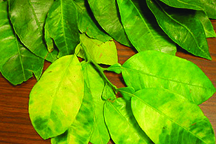
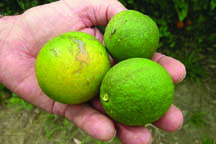 Here in the Rio Grande Valley the first known case of HLB was confirmed in a San Juan orange grove on Jan 13, 2012.
The tree showed the telltale signs: undersize, discolored fruit and curled, mottled yellow leaves. Soon the disease had spread wide enough to bring the Valley's citrus harvest season to a dead standstill as the United States Department of Agriculture investigated how far it had spread. Quarantined citrus growers cautiously resumed harvesting their crops on February 1 of that year.
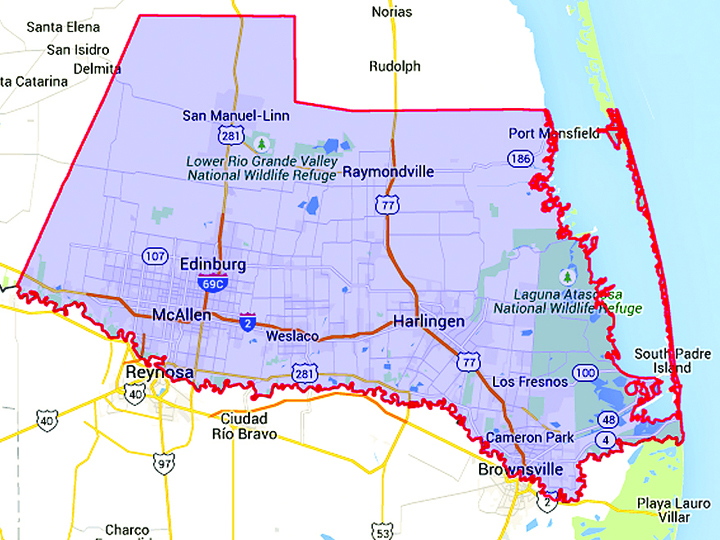 On December 9, 2014, the Texas Department
of Agriculture established a quarantine
zone including all of Cameron, Hidalgo
and Willacy counties.
source: texasagriculture.gov
On December 9, 2014, the Texas Department
of Agriculture established a quarantine
zone including all of Cameron, Hidalgo
and Willacy counties.
source: texasagriculture.gov
If you live in the quarantine zone (shown here) and own citrus plants, you are not allowed to move citrus plants or plant materials (leaves or twigs) outside of the quarantine zone. Citrus plants include orange, grapefruit, lemon, lime, kumquat, tangerine or orange jasmine.
If you suspect Citrus Greening on your trees
please call 956-580-1917
To read more about Citrus Greening visit www.citrusalert.com
The Valley Spotlight is here to provide information regarding all aspects of life in the Rio Grande Valley of Deep South Texas. We welcome all feedback in the format of "letters to the editor". We invite you to submit ideas for feature articles on any aspect of life here in the RGV. We invite non-profit charitable organizations to submit information for consideration. Do you have an interesting story to tell about your experiences here in the Valley? If so contact us for consideration. Does your club or organization have the need to get the word out about your events? If so, contact us! This publication is for and about you, the residents of The Rio Grande Valley. Let us know what you would like to see printed here. If you would like to receive printed copies of The Valley Spotlight, contact us. For all of the above communications, email rod@rgvaff.com
Canadians make up a large percentage of Winter Texans, in our Resort over 50%, and we spend a lot to support the local economy in the Valley. But it is becoming more and more difficult to justify this expense, certainly in large part due to the dollar difference, but also due to increasing lot rental costs, mounting local taxes and increasing costs for out-of-country health care coverage (which goes up every year as we age).
One saving grace is that gasoline prices this season are much more reasonable. Unfortunately however, this is the very cause of our depreciated Canadian dollar).
It is reasonable to see why many of the parks & resorts in the Valley have much lower occupancy rates this year. Many of our Canadian friends here have put their homes up for sale or are staying for a shorter time this year.
There is no light at the end of the tunnel yet since oil prices (the major determinate of Canadian dollar value) do not seem likely to rise any time soon.
Are there any immediate solutions? Yes!
Offering park / resort fees and other services at Canadian par would certainly attract more residents, as would summer discounts on lot rentals (when we aren't here to use the amenities).
Canadian fees at par were tried here in the Valley in 2003, the last time there was such a difference between the US and Canadian dollar. And it worked!
Leap Day - Monday, February 29
Leap Day is every fours years....almost.
It's every four years except years ending with "00" that are not divisible by 400. The year in which Leap Day occurs, is called a Leap Year.
Why the fancy calculation? The earth rotates around the sun once every 365 and about 1/4 days. So, by adding an extra day every four years, we get mighty close to keeping the calendar consistent with the earth's annual trip around the sun.
And to be very precise, the earth orbits the sun every 365.242190 days. So, on years ending in "00", (except those not divisible by 400) we skip Leap Year and Leap Day. With all that fancy calculating out of the way, let's just celebrate the day.
Did you know?
There are occasional "Leap Seconds". We will spare you the detail on those, except to say it helps to correct minor variations.
On December 31, 2015, the folks who maintain the official time for the planet, will add an extra second to the day!
If your birthday is on Leap Day, congratulations, you finally get to celebrate your birthday on your birth date. Just how many of us are celebrating our Birthday on Leap Day? Only about one in 1461 people. If you were born on this day, consider yourself very, very special.
True Tales of a Valley Birder
Best Birding in Texas is South Texas
by Keith Hackland (alamoinn@aol.com)
photo credits: Steve Sinclair
Texas leads the United States and Canada in birding. Our state has some 640 species on record. That count is governed by the Texas Bird Records Committee, a group of experts who are very careful before recognizing a new species to add to the state list.
There have to be good photos and reports by reliable birders who are known in the birder community. It also does not normally include escaped (exotic, feral) birds, even if they are breeding.
How Many and Where
The best birding in Texas is in South Texas, along the coastal wetlands and Rio Grande wetlands, and adjoining areas. For most of the coastal areas 75% of the birds found in Texas use these areas of South Texas, that is about 480 species. Some of these 480 species are full time residents, some part time seasonal residents, while others pass through as migrants. 338 species are migrants, moving through the area or wintering here. Some 147 species reside year round.
In United States there are 338 migratory bird species. 333 of these, 98%, are found in South Texas. This makes South Texas of great importance. It is an area where species come and go, a canvas of birds, changing seasonally, changing with weather variations, and changing with geography, and changing with habitat.
Seasonal Changes
Seasonal changes are easily understood. In the fall, migrants, neo tropical species, return south to their homes after nesting in U.S. and Canada. They take their time, using southern winds to help them fly south, feeding on fall harvest delicacies of fruit, grain, nuts, insects, mammals and other birds.
Fall migration takes place from June through December, though the heaviest migration is August through November, when hawk watch takes place, counting raptor migrants. This is done at Smith Point and Sylvan Beach in South East Texas, and at Hazel Bazemore Park on the Coastal Bend outside Corpus Christi. This latter count point sees the highest counts.
Migrants
There are three major migratory flyways that lead birds into Texas: Eastern Atlantic flyway (which brings mainly land migrants), Mississippi Flyway and Central Flyway (which bring all migrants). Two types of migrants cross Texas, the circum Gulf (land) migrants and the cross Gulf migrants. The fourth North American flyway is the Western Flyway, and some of its birds also use Texas lands.
Large migrant species, such as raptors and water birds follow the land, meaning that when they reach the Gulf of Mexico, they turn west and follow the coast around through Texas into Mexico and continue south over land. Land migrants are generally heavier birds that do not have the ability to fly across the Gulf of Mexico.
Some species fly at night, resting up and eating during the day. The day flying species take advantage of thermals. Thermals are columns of warm air rising off the land. Birds use the columns as elevators, allowing the rising air to lift them thousands of feet into the air. When they are high up they leave the elevator and glide for tens of miles, until they find another thermal to ride up. Birds riding on these air elevators do so in flocks, called kettles. Kettles can be seen from many miles away, which is helpful to the birds who are seeking them.
Smaller, lighter migrants, including song birds, humming birds, and shorebirds, have the ability to fly right over the Gulf of Mexico. They typically do this at night, flying for up to 16 hours to reach land, often covering around 800 miles. They depart from the Gulf Coast at many points, preferring land that reaches out into the Gulf, generally in Texas the Barrier Island at Galveston, Mustang, and Padre. Spring migration is a much more concentrated affair, which sees song birds hurrying through to reach their breeding grounds while insect life is at its peak. Insects provide the essential protein for nestlings. The raptors move through first from mid-March through late April. There are hawk watch counts in South East Texas at Sylvan Beach, and in the Lower Rio Grande area at Bentsen Rio Grande Valley State Park, and at Santa Ana National Widlife Refuge.
The song birds follow, from early April to the end of April in South East Texas, and continuing to late May in the Lower Rio Grande area. Since song birds prefer to fly when they have a tail wind, they tend to leave in concentrated groups when conditions are ideal. Researchers count migrants as they fly overhead at night. They use audio devices to record their calls and then estimate the numbers of calls. This is being done in and adjacent to the Lower Rio Grande Valley. At peak times at a given point the number of calls recorded indicates one million birds per hour passing overhead. This is the heaviest migration rate recorded on earth.
HELPING HANDS at Alamo Rec Veh Park
HELPING HANDS Sewing Group, formerly known as Mission Sewing, has been in existence since approximately 1983 and was started with a group of 23 women and no men.
The group now consists of male and female volunteers who meet on Tuesday mornings in the Annex at Alamo Rec Veh Park in Alamo, TX.
Over the 32 years of existence several thousand quilts have
been made and hundreds of residents in the Valley have benefited.
In 1983 the quilts were made using templates and scissors
to cut the blocks, eventually moving in to the modern
world of rotary cutters and rulers.
Gradually, over the years, they added making bibs and afghans for the nursing homes and crocheted and knitted chemo hats for children. Helping Hands owns and furnishes all supplies and sewing machines needed to keep the volunteers busy at these tasks. Maintenance and furniture moving is also taken care of by volunteers.
We have been very fortunate in receiving quilt tops from a group up north as well as those we make. On Tuesdays, we have a production line of cutters of blocks; pinning the tops together; sewers; sandwiching of tops, batting and backing; sewing of binding and labels and then to the tyers to complete the quilts. The quilts are made in three sizes; adult, youth and toddler and are donated to hospitals, nursing homes, colonias, fire departments, the Children's Cancer Center, Women's Shelter and the Silver Ribbon Program for abused and disabled adults.
All of the projects are made by volunteers and the costs are met by donations and funds raised at the Quilt and Hobby Show. Residents also collect toiletries during their travels from motels/hotels and these are given out to the Women's Shelter and colonias.
All residents at Alamo Rec Veh Park who are hospitalized receive a quilt to show our support, comfort and keep them warm during their recovery. The Quilt and Hobby Show held the first Thursday in February is sponsored by Helping Hands and residents are encouraged to enter the show and show off their talent in woodworking, painting, jewelry making, knitting, crochet etc. and of course, quilting. There are multiple door prizes and a quilt given away during the show to lucky winners. This show has become a very successful endeavor and is known throughout the Valley.
All proceeds from the show and donations go to support Helping Hands in the costs of this great endeavor. We continue to strive to assist meeting the needs of the needy in the Valley through our wonderful Volunteers.
National Freedom Day - Monday, February 1
Major Richard Robert Wright Sr., a former slave, created National Freedom Day. He believed that there should be a day when freedom for all Americans is celebrated. President Lincoln signed the 13th Amendment outlawing slavery on February 1, 1865.
The first commemoration of such a day took place on February 1, 1942, although it was not made into law yet. A tradition of laying a wreath at Liberty Bell also began.
On June 30, 1948, President Harry Truman signed a the bill proclaiming February 1st as National Freedom Day to remind us that America stands for, and is a symbol of freedom for all people.
Celebrate this day by reflecting upon your own freedoms and remember that millions of people in the world are not free.
New Year, New Home
There is much to look forward to this year at The Boys and Girls Clubs of Weslaco Inc. The board is proud to announce that ground has been broken! The building's steel structure is currently erected, bricks are being laid and the interior designing has commenced. This brand new site will be opening in the month of April and as mentioned in September, will feature a computer room and classrooms for more space to learn, a kitchen for preparing healthy meals and snacks, and a full court gym.
The club will continue to offer flag football, and baseball leagues. You can now expect volleyball leagues, men's and women's basketball leagues, fitness classes and much more.
With all this new space the possibilities are endless! We are currently serving 120 members at our present site and with the new facility we will be able to more than double the amount of members. The new site will be located at Pablo Pena Park on Airport Drive.
Best Memories of 2015
Although there is so much to get excited about looking towards the future of The Boys and Girls Clubs in Weslaco, this year was one for the books! This past year was full of fun and games, learning and creativity, and raising awareness. The students participated in activities and events such as a magic show in the auditorium, healthy habits, pool tournaments, arts and crafts, fire and cancer awareness and much more. Awards and recognition were given to this past year’s Speedy Readers and Junior Youth of the Year.
For the holidays Old St. Nick visited the kids and brought Christmas gifts and goodies for everyone. After taking their photo with Santa the kids were in for a real treat! Santa Clause hung around and read them a good old Christmas story in front of the fireplace. Moments like these at The Boys and Girls Club truly brings joy to all.
Special Thanks
This last year has been great to all of us here at the Boys and Girls Clubs of Weslaco Inc. We can't wait to see what's in store for next year! The board would like to extend a special thanks to its directors and staff for making it a successful 2015!
The Boys and Girls Clubs of Weslaco Inc. impacts the lives of young people in vital areas such as academic success, good character and citizenship, and healthy lifestyles.
Volunteer South Texas Week 2016 is almost here!
United Way of South Texas has announced that the week of April 10-16, 2016, (Sunday through Saturday) will be Volunteer South Texas Week 2016, a week to showcase to the world the many ways South Texans passionately serve in their communities!
Last October, United Way of South Texas launched Volunteer South Texas volunteersotx.org , a FREE "one-stop-shop" for potential volunteers to connect with non-profit agencies, schools, and governmental institutions in our communities.
This website Is a new opportunity to connect volunteers with meaningful service projects right here in Hidalgo and Starr Counties of South Texas.
Over 60 non-profit agencies, schools, and governmental institutions have already signed up on Volunteer South Texas and are now able to easily advertise volunteer opportunities, in-kind needs, and special events to our communities.
Potential community volunteers can now browse what needs exist and then register to volunteer to fill a specific need and/or to be automatically notified when volunteer opportunities arise around their passions. Registration can even be done right on your smartphone!
To celebrate Volunteer South Texas Week 2016, over the next couple of months, non-profit agencies, schools and governmental institutions throughout South Texas will post needs for volunteers specifically for the week of April 10-16.
United Way of South Texas will publicize the week's opportunities for service. Volunteers will then click on the "Respond" button on Volunteer South Texas on the opportunity in which they want to serve and the individual agencies will contact each volunteer to schedule the specific tasks needed that week. T-shirts will be given to all participants in the week’s service projects who have signed up through Volunteer South Texas.
McAllen Mayor Jim Darling (our Honorary Volunteer South Texas Week 2016 Chairman) and the mayors of many of the communities in Hidalgo and Starr Counties will lead us as we serve at food pantries, in after school programs, or at a beach cleanup (examples only).
Once the week's activities are completed, we'll tabulate the number of volunteers that served in our communities, the number of hours served, and the value to our communities from this week of volunteer service.
Make plans to join us April 10-16, 2016, for Volunteer South Texas Week 2016! Check back on Volunteer South Texas volunteersotx.org often and reserve your spot at a community agency near you!
Jeepers Just Want To Have Fun!
by Alyssa Cavazos
Jeep Night this January was intended for Jeepers to meet up and have a leisure evening. This month we took a break from the competitions and just enjoyed each other's company. Sofie's 'SS' Saloon was the spot for the monthly meeting.
Burns Motors' David Nunez delivered once again and grilled up some barbecue for Jeep Night, which was sponsored by Burns Motors. The hours flew by as guests enjoyed good food, great music, and awesome company. With the pressures of competition and awards absent, Jeepers were able to hang loose and intermingle.
As everyone knows, Super Bowl Sunday is just around the corner.
Jeep Nights are usually held on Thursdays but February's Jeep Night theme will be "Super Bowl 2016" Party and of course will be held on Sunday, February 7.
Burns Motors' Big Lew was generous enough to host February's Jeep Night at his home in San Manuel. For those attending next month Jeep Night, it will begin at 3:00pm. Barbecue will be ready by 5:00pm and the game will be starting at 5:30pm. Guests will also enjoy other activities such as basketball, football, and corn hole. It is recommended guests bring seats with them.
For more information on next month's Jeep Night, such as Big Lew's address or directions to the location, please contact:
Burns Motors' Big Lew, Texas Jeep Crawler's Lou Bar, Texas Off-Road Republic's Jesse Pena, or South Texas Rebels' Fred Marroquin.
To keep updated on all Jeep Night information and events be sure to like our official Facebook page "Jeep Night powered by Burns Motors".
For additional information or questions Big Lew can also be contacted at 956-984-4454 or by email at biglew@burnsmotors.com
Be My Valentine
Valentine's Day is the day when people show their affection for another person or people by sending cards, flowers or chocolates with messages of love.
Traditionally on Valentine's Day in a leap year - every four years - women can propose marriage to their partner!
The day gets its name from a famous saint, but there are several stories of who he was. The popular belief about St. Valentine is that he was a priest from Rome in the third century AD. Emperor Claudius II had banned marriage because he thought married men were bad soldiers. Valentine felt this was unfair, so he broke the rules and arranged marriages in secret.
In the United States, about 190 million Valentine's Day cards are sent each year, not including the hundreds of millions of cards school children exchange.
Valentine's Day has become a popular gift-giving event. In fact, in the United States alone, the average valentine's spending has increased every year, from $108 a person in 2010 to $131 in 2013.
The Magic Valley's Golden Egg
The origin of the Grapefruit has been a puzzle to historians and pomologists for years. The only citrus strain not found to have originated in Southeast Asia, the grapefruit was obtained in the West Indies around the 1700s. Years later, research confirmed that grapefruit is a hybrid of a pummelo, and the sweet orange.
Originally known as "the forbidden fruit", it wasn't until the 1800s that a Jamaican farmer called the fruit "grapefruit" for the grape-like cluster in which it grows on trees. In 1823, grapefruit made its way to the United States in the form of seeds brought by either Spanish or French settlers to Florida, eventually making its way to South Texas, most likely by visiting Spanish missionaries.
The Father of the Texas Citrus Industry
In 1912, John H. Shary made his way to the Rio Grande Valley which was at the time largely brush and cactus. Shary was impressed with citrus crops that were being grown by early citrus experimenters and saw a great opportunity in developing the Valley as a citrus growing region.
Citrus crops needed irrigation and in 1914 Shary purchased the First Lift Station which pumped life giving water from the Rio Grande to irrigate 15,000 acres of surrounding crops.
The chimney from the lift station has been
designated a Texas historical landmark and is still standing at the site of Chimney Park in Mission, Texas.
That following year Shary planted the first commercial citrus orchard. His first crops were seeded white grapefruit. His citrus empire would eventually grow to almost 15,000 acres of groves. The first commercial shipments of citrus, packed in onion crates, were shipped from the lower Rio Grande Valley in 1920. By 1922 much of the land had been transformed into citrus groves, and cotton, onion, and vegetable fields.
Shary took the lead in organizing and building the United Irrigation Company, in order to assure water supplies for future developments.
Because of his significant role in the development of the area, Shary was named to the Texas Business Hall of Fame and is remembered as the "Father of the Texas Citrus Industry".
He greatly assisted in the establishment of citrus as a productive commercial crop in the Rio Grande Valley. Since 1932, the Texas Citrus Fiesta has been held to commemorate the abundant harvest of the Texas citrus industry. To this day, this area is known for producing some of the sweetest and best quality citrus in the world.
Grapefruit Has Many Healthy Benefits
But Beware of Combining It With Some Prescription Drugs
Grapefruits are low in calories but are full of nutrients and an excellent source of vitamins A and C.
Grapefruits support clear, healthy skin, can help to lower our risk for many diseases and conditions and may even help with weight loss as part of an overall healthy and varied diet.
According to the American Heart Association, eating higher amounts of a compound found in citrus fruits like oranges and grapefruit may lower ischemic stroke risk for women.
The powerful nutrient combination of fiber, potassium, lycopene, vitamin C and choline in grapefruit all help to maintain a healthy heart. As an excellent source of the strong antioxidant vitamin C as well as other antioxidants, grapefruit can help combat the formation of free radicals known to cause cancer.
Lycopene intake has been linked with a decreased risk of prostate cancer prevention in several studies and foods high in vitamin C and beta-carotene have been shown to lower the risk of esophageal cancer in particular.
Grapefruit, because of its water and fiber content, helps to prevent constipation and promote regularity for a healthy digestive tract.
As one of the most hydrating fruits in the world made up of 91% water (just below watermelon) and full of important electrolytes, grapefruit is a great snack to have on hand to prevent dehydration.
The risks for developing asthma are lower in people who consume a high amount of certain nutrients. One of these nutrients is vitamin C, found in many fruits and vegetables including grapefruit.
NOTE:
Some individuals who take prescription medications should be extra cautious when incorporating grapefruit into their diets. Grapefruit has a strong interaction with some of the most widely prescribed medications.
Why? Grapefruit contains a compound called naringenin that inactivates cytochrome P450 3A4. This slows down the normal detoxification and metabolism in the liver and intestines, which makes it harder for the body to eliminate and breakdown the drug. Not only can grapefruit decrease the function of a drug, but it can also enhance making the drug more potent. Both of these side effects are no good when you're trying to regulate a medical condition with a prescription drug. Best advice is to do your research and ask your physician.
Eating Grapefruit
There are many ways to enjoy fresh grapefruit. The simplest is to peel it, pull the sections apart and eat it just as you would an orange.
Because grapefruit has a sweet / bitter flavor many folks will cut it in half, separate the sections from the membranes and sprinkle a little sugar on it. Then you just dig in with a spoon.
If you are a bit more adventurous you can try the recipies shown here or find more ways to enjoy grapefruit at www.texasweet.com
However you decide to eat it, remember to thank those early pioneers who had the foresight to develop our Magic Valley into the Citrus Capital of Texas!
Grapefruit Brulee
Cut a grapefruit in half, then cut between the membranes to loosen the segments, but keep them in place. Sprinkle each half with 2 teaspoons superfine sugar. Caramelize the sugar with a kitchen torch. Top with raspberries.
Sparkling Grapefruit Pie
Ingredients:
1 (9 inch) pie crust, baked
4 pink grapefruit
1/2 cup white sugar
1 tablespoon cornstarch
3/4 cup grapefruit juice
1 (3 oz) package strawberry flavored Jell-O
Directions:
Peel grapefruit, removing all pith. Cut up into bite-size pieces. Drain in a strainer for 4 or more hours, collecting the juice. (This can be done the day before.) Combine the sugar, cornstarch, and 3/4 cup juice in a small saucepan; if the collected juice does not measure 3/4 cup, top it off with water. Bring to a boil. Stir in strawberry gelatin. Cool slightly. Spread grapefruit in the bottom of the baked shell, and pour gelatin over the fruit. Chill several hours or overnight.
This Little Monster Could Be In Your Backyard!
There is a nasty bug going around causing a lot of concern for citrus growers in the Valley. Whether you are a commercial farmer or a backyard citrus enthusiast ... Yellow Dragon Disease should be at the top of your priority list.
First reported in China in 1943, this disease has spread throughout Asia and has found its way to the United States. Evidence of the disease was first found in Florida in 1998. Since then it has spread across Mexico, Texas and California.
Technically, Yellow Dragon Disease is Huanglongbing (HLB), most commonly known as Citrus Greening Disease. At the root of the problem is a bacteria which infects a citrus plant. This bacterial infection is spread by the Asian Citrus Psyllid (ACP) moving from tree to tree feeding on new growth.
At only one five-thirty-seconds of an inch long the Asian citrus psyllid and its microscopic hitch-hiker pose a major threat to the citrus crops of the Valley.
Here in the Rio Grande Valley the first known case of HLB was confirmed in a San Juan orange grove on Jan 13, 2012.
The tree showed the telltale signs: undersize, discolored fruit and curled, mottled yellow leaves. Soon the disease had spread wide enough to bring the Valley's citrus harvest season to a dead standstill as the United States Department of Agriculture investigated how far it had spread. Quarantined citrus growers cautiously resumed harvesting their crops on February 1 of that year.
On December 9, 2014, the Texas Department
of Agriculture established a quarantine
zone including all of Cameron, Hidalgo
and Willacy counties.
source: texasagriculture.gov
If you live in the quarantine zone (shown here) and own citrus plants, you are not allowed to move citrus plants or plant materials (leaves or twigs) outside of the quarantine zone. Citrus plants include orange, grapefruit, lemon, lime, kumquat, tangerine or orange jasmine.
If you suspect Citrus Greening on your trees
please call 956-580-1917
To read more about Citrus Greening visit www.citrusalert.com
The Valley Spotlight is here to provide information regarding all aspects of life in the Rio Grande Valley of Deep South Texas. We welcome all feedback in the format of "letters to the editor". We invite you to submit ideas for feature articles on any aspect of life here in the RGV. We invite non-profit charitable organizations to submit information for consideration. Do you have an interesting story to tell about your experiences here in the Valley? If so contact us for consideration. Does your club or organization have the need to get the word out about your events? If so, contact us! This publication is for and about you, the residents of The Rio Grande Valley. Let us know what you would like to see printed here. If you would like to receive printed copies of The Valley Spotlight, contact us. For all of the above communications, email rod@rgvaff.com